/
Source: New York Review of Books
In January, when The New York Times
asked DonaldTrump whether there were any limits on his global powers,
he replied, “Yeah, there is one thing. My own morality. My own mind.”
Since whatever morality he ever possessed has long since departed, the
remaining question is whether he has also lost his mind. Given that, in
the course of his war on Iran, he has chosen to present himself to the
world as a genocidal maniac—posting on Truth Social that “a whole
civilization will die tonight, never to be brought back again. I don’t
want that to happen, but it probably will”—the answer may seem all too
obvious.
Yet
to arrive at it we have to tease out the relationships that are always
at the heart of his persona: the complex connections between performance
and reality, method and madness, bombast and bombs. With Trump, these
oppositions are never absolute. The borders between them are always
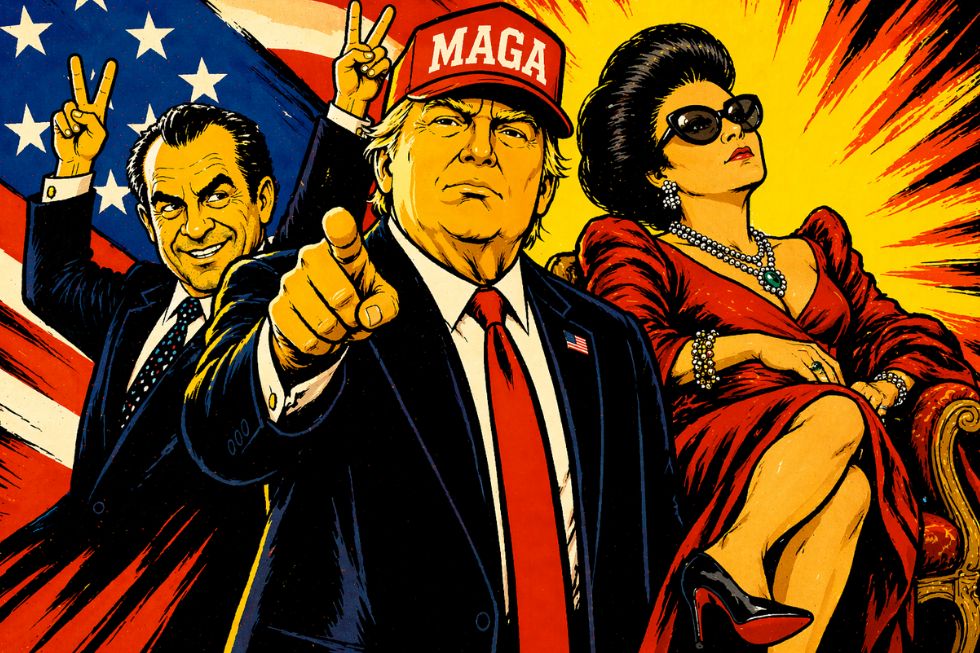
porous. On the one hand, there’s no doubt that in Trump’s chaotic mind
there lurks the Madman Theory, a belief that acting crazy is a rational
strategy. Richard Nixon coined the phrase for his chief of staff, H.R.
Haldeman, during the Vietnam War:
I call it the Madman Theory, Bob. I want the North Vietnamese to believe I’ve reached the point where I might do anything to stop the war. We’ll just slip the word to them that “for God’s sake, you know Nixon is obsessed about Communism. We can’t restrain him when he’s angry—and he has his hand on the nuclear button”—and Ho Chi Minh himself will be in Paris in two days begging for peace.
The
belief that Trump has been following Nixon’s playbook in relation to
Iran has been a staple of recent media analysis. It is certainly valid.
Yet it raises a further question: Is it possible for someone to act the
lunatic while actually being one? We are faced with a vastly more
consequential version of a Catch-22. In Joseph Heller’s novel, claiming
to be crazy is taken as evidence of sanity. Likewise the only evidence
that Trump might not be crazy is his obvious determination to seem so.
To
get our bearings in this maze we might begin with Irving. He appears,
shorn of a surname, in the book Tony Schwartz ghostwrote for Trump, The Art of the Deal
(1987). While still at college, Trump has done his first deal, buying
with his father and refurbishing an apartment complex in Cincinnati. He
hires Irving to manage the project. Trump suspects that he is a thief
and calls him “a short, fat, bald-headed guy with thick glasses and
hands like Jell-O, who’d never lifted anything in his life beside a pen,
and who had no physical ability whatsoever.”
But
his saving grace is “an incredible mouth.” According to Trump, Irving
would collect rents from the most recalcitrant tenants by putting on a
show of frenzy:
He’d ring the doorbell, and when someone came to the door, he’d go crazy. He’d get red in the face, use every filthy word he could think of, and make every threat in the book. It was an act, but it was very effective: usually they paid up right then and there.
One day, while Irving was on his rounds, he knocked on a door, and a little ten-year-old girl answered. Irving said, “You go tell your father to pay his f—ing rent or I’m going to knock his ass off.”
Irving,
says Trump, “left a very vivid impression on me.” Trump learned early
on that screaming obscenities at ten-year-old girls and making every
threat in the book was a good way to get what he wanted. There would
seem to be a clear path from Irving to the flamboyantly demented Trump
of his Easter Sunday morning post: “Tuesday will be Power Plant Day, and
Bridge Day, all wrapped up in one, in Iran. There will be nothing like
it!!! Open the Fuckin’ Strait, you crazy bastards, or you’ll be living
in Hell – JUST WATCH! Praise be to Allah.”
For
Trump’s apologists, he is thus not a mad King Lear, an (almost)
eighty-year-old monarch raving on the heath. He is a Hamlet who has
chosen “to put an antic disposition on,” the better to achieve his
purposes. There’s every reason to believe that this is the way Trump
sees himself. William Barr, who served as Trump’s attorney general in
the latter part of his first term, recalls in his memoir, One Damn Thing After Another (2022), an occasion when Trump wished to make a public claim of vindication:
Then, studying me, with a twinkle in his eye, he added, “I am going to go and tweet about this.”
I glanced up with a look of discomfort. He smiled playfully. “Do you know what the secret is of a really good tweet?” he asked, looking at each of us one by one. We all looked blank. “Just the right amount of crazy,” he said.
Likewise,
Nikki Haley recalled that when she was serving as his ambassador to the
United Nations, Trump told her how to deal with the North Koreans:
“Tell them you just talked to the president…. Make them think I’m
crazy.” In 2017 Axios
reported an exchange between Trump and his trade representative Robert
Lighthizer, who was negotiating with South Korea: “I’ll tell the Koreans
they’ve got 30 days,” Lighthizer said. Trump rebuked him: “No, no, no.
That’s not how you negotiate. You don’t tell them they’ve got 30 days.
You tell them, ‘This guy’s so crazy he could pull out any minute.’” In
2024 Trump told The Wall Street Journal’s
editorial board that he would not have to use military force to prevent
a Chinese blockade of Taiwan, because President Xi “respects me and he
knows I’m f—crazy.”
The
conviction that putting on an antic disposition is a winning
geopolitical strategy has a long history. Henry Kissinger articulated it
in a lecture in Peshawar in 1962. In the cold war confrontation with
the Soviet Union, he said,
the only way one can communicate one’s determination, I think, is by conducting a policy in which one indicates a high capacity for irrationality. What one has to do is prove that in certain situations one is likely to go out of control, and that regardless of what sober calculation would show one is simply so nervous that the gun is going to go off. A madman who is holding a hand grenade in his hand has a very great bargaining advantage.
In
this theater of bluff, the president of the United States is Irving
writ large. If he goes red in the face, uses every filthy word he can
think of, and makes vile threats, he is in fact being coldly calculating
and lucidly shrewd. According to this line of thinking, there is not
just a gap between appearance and reality—the two are complete
opposites. The rationale is that the higher the seeming capacity for
irrationality, the more rational the president is because the more
probable it is that the enemy will be terrified and make large
concessions. By this logic, Trump’s genocidal ravings at Iran are proof
that he really is, as he insists, a very stable genius.
The
Chinese, of course, have a dismissive phrase of their own for the
Madman Theory: paper tiger. Like all performances, the crazy act must be
able to command at least a suspension of disbelief. In Trump’s case,
his infinite hype produces diminishing returns of credibility. His
warning in 2017 that “we will have no choice but to totally destroy
North Korea,” whose threats would be “met with fire and fury like the
world has never seen,” was followed the next year by his declaration
that he and Kim Jong Un “fell in love” after exchanging letters. The
paper tiger went into the shredder.
The
odd thing, though, is that these two realities—that Trump is playing
out his own version of the Madman Theory and that his act has long worn
thin—seem to point toward the same apparent conclusion. The first
appeals to his fans, the second to his detractors. But both suggest that
there is only the show. Some think it’s a great show, some think it’s
terrible. Yet the truth is that Trump is always acting in both senses.
There is no border between pretense and practice, shadow and substance.
Shakespeare
gives us more than Lear or Hamlet, real or feigned mental derangement.
There is a third possibility. Titus Andronicus begins by pretending to
be mad and then becomes so in reality. To translate this into the
history of the American presidency, we need only return to Nixon. Just
because you’ve invented and acted on the Madman Theory doesn’t mean you
can’t go mad: Nixon’s paranoia, enemies lists, conspiracy theories, and
seemingly drunken order to nuke North Korea do not speak of robust
mental health. The Madman Theory, it seems, can be a self-fulfilling
prophecy.
Trump’s
genocidal threats are a much madder version of the theory than anyone
previously had in mind. They go against two of its basic requirements.
When Kissinger set it out in 1962, he added that unfortunately, “given
the public opinion of Western democracy, this is not a policy that can
be conducted.” The Madman Theory, even when put into practice by Nixon,
is a strictly limited form of coterie theater. The performance is only
for hostile governments. It must be kept from one’s own citizens because
public opinion matters; the leader of a democracy does not want his
voters to think he has truly lost his marbles.
Second,
Kissinger suggested that since there were such limits on democratically
elected leaders’ use of the strategy, the alternative for the US was to
transform its alliances “from what were in effect unilateral American
guarantees” into “efforts of real cooperation to prevent threats to
countries from being overrun.” The US can’t have its allies thinking
that its president has gone crazy either. So it must instead offer them
real cooperation in joint efforts to deter invaders.
Trump’s
homicidal hysteria breaks both of these rules. It is not a private
performance for the benefit of a highly select audience (in this case
the members of the Iranian regime). It is a stadium spectacular,
simulcast live to the whole world. It displays psychosis to American
voters and to America’s allies. It sunders any common interest with
friendly European and Anglophone nations. It is thus unmoored from the
constraints either of democracy or of alliance.
This
does not merely indicate “a high capacity for irrationality.” It is
actually and wildly irrational. It makes a kind of sense only if one’s
own voters and one’s supposed international allies are also legitimate
targets of the mad threats, if they too are to be terrorized by the
specter of the deranged emperor. Trump’s mad act has a logic only if the
performer this time really sees both voters and allies as enemies to be
overawed.
Trump
told Barr that a good tweet has “the right amount of crazy.” His
capacity for that kind of calibration has never been impressive: if the
original benchmark is screaming obscenities at ten-year-old girls, fine
gradations are probably not in his skillset. But however skilled he may
once have been, it is now obvious that he can no longer control the
dosage. Threatening genocide is the wrong amount of crazy—wrong in
itself but also wrong because it tells those at whom the threat is aimed
that they have nothing left to lose. They may as well bring as many of
their enemies down with them as they can.
It
would be impertinent to offer a clinical diagnosis of Trump, though
that is not a courtesy he has afforded others. He reportedly called his
first attorney general, Jeff Sessions, “mentally retarded”; repeatedly
cast doubt on whether Joe Biden was “mentally fit to be president”; said
his chief of staff John Kelly “wasn’t mentally fit for the job”;
claimed that “Kamala Harris doesn’t have the mental capacity to do a REAL Debate against me”; and called his former national security adviser John Bolton a “total & unhinged WARMONGER, the red faced ‘boiler ready to explode’ was one of those very stupid voices that got us into the Middle East quicksand.”
But
whatever its clinical definition, the political diagnosis of Trump’s
form of madness was made a long time ago by Thomas Hobbes in Leviathan:
The Passion, whose violence, or continuance maketh Madnesse, is either great Vaine-Glory; which is commonly called Pride, and Selfe-Conceipt…. Pride, subjecteth a man to Anger, the excesse whereof, is the Madnesse called RAGE, and FURY.
Or, in this case, Operation Epic Fury.
Fury,
Hobbes wrote, arises when a belief that one is uniquely inspired
clashes with the refusal of others to bend to this exceptional insight:
“If there were nothing else that bewrayed their madnesse; yet that very
arrogating such inspiration to themselves, is argument enough.” While
sane people “would be unwilling the vanity and Extravagance of their
thoughts…should be publiquely seen,” those in the grip of this delusion
are all too happy to put them on display. Hobbes pointed out that if
someone were to tell you that he “were God the Father,” you would
require no further proof of madness. When Pope Leo XIV recently
denounced “the delusion of omnipotence,” Trump replied by posting an AI-generated
image of himself as Jesus healing a sick man in a bed while a soldier
and a nurse look on in awe. Trump is the Savior whom Leo is pledged to
serve—the ultimate in one-upmanship.
Rage
and fury are the words Shakespeare most often associates with madness.
We know that as soon as Trump was elected in 2016, those Republicans who
saw him up close began to dread the eruption of his unbridled temper.
According to Bob Woodward and Robert Costa in Peril
(2021), the then speaker of the house Paul Ryan felt it necessary to
read up on narcissistic personality disorder: “Ryan’s main takeaway: Do
not humiliate Trump in public. Humiliating a narcissist risked real
danger, a frantic lashing out if he felt threatened or criticized.”
This
frantic lashing out has been described over and over by those who
worked with Trump in the White House during his first administration. “I
thought about Trump’s anger. I heard his voice screaming in my head,”
recalled the loyal White House aide Cliff Sims. “Trump was railing about
everyone at that time. He called Federal Reserve chairman Jerome Powell
‘a dirty bastard, that motherfucker,’” recalls the former White House
press secretary Stephanie Grisham in I’ll Take Your Questions Now
(2021). The chairman of the joint chiefs of staff Mark Milley “was
certain Trump had gone into a serious mental decline in the aftermath of
the [2020] election, with Trump now all but manic, screaming at
officials and constructing his own alternate reality about endless
election conspiracies.”
The
relevant point about these maniacal outbursts is that they are not
performative. They are not strategic enactments of the Madman Theory.
They are merely the way he is. Grisham believed that Trump’s public
rages were performative until she experienced them in private:
I was not prepared for the way he spoke to or yelled at people, which I know sounds crazy when you consider his Twitter account or even his interviews with the press. But when I began to see how his temper wasn’t just for shock value or the cameras, I began to regret my decision to go to the West Wing.
This
fury—constantly compared by those who worked with him to the tantrums
of a toddler—is, as Ryan realized, dangerous, and all the more so when
allied to another aspect of his character: his loss of a connection to
objective reality. Rage has to be controlled when it comes up against
outside limitations, but there is a sense in which, for Trump, there is
no outside. According to The Divider
(2022), Peter Baker and Susan Glasser’s history of Trump’s first term,
John Kelly and “other top officials who served during the Trump
administration came to believe that Trump was mentally ill, unable or
unwilling to process basic information necessary to do his job, and
dangerously uninformed.” Kelly himself “considered Trump a pathological
liar, not just someone disconnected from reality but someone who did not
even seem to understand that there was a reality other than what he
decided it was.”
These,
bear in mind, are testimonies from Trump’s first term, when he was a
younger man and showed fewer signs of cognitive decline. The fury of
thwarted narcissism and the lack of any sense of an external reality can
only be more dangerous in a second term, when Trump is even more
disinhibited, hearing only voices that, in all their sycophantic echoing
of his own desires, might as well be inside his head.
The
case for invoking the Constitution’s Twenty-Fifth Amendment and
removing Trump from power is strong, and Trump himself joked about it
during a cabinet meeting in late March. “I can’t say what we’re going to
do, because if I did, I wouldn’t be sitting here for long. They’d
probably—what is it called? The Twenty-Fifth Amendment?” Democrats in
Congress have become much more willing to call openly for Trump’s
ejection on the grounds of his mental incapacity to govern. But the same
Republican obsequiousness that has made Trump’s madness ever more
dangerous makes his removal a practical impossibility.
The
madness, after all, is not just personal. It is structural. When the
balance of power is lost and democratic accountability is replaced by a
cult of the divinely inspired leader, the conditions that exacerbate
derangement become the principles of governance. Writing of the Nixon
White House, Arthur Schlesinger remarked:
In such conditions wish tended to rule fact and, in George McGovern’s phrase, government fell prey “to its own delusions and fantasies.” At the far end of this road lay the madness of totalitarian government, where leaders tried to remold reality by force of personality and terror.
Nixon
fell, but the American republic itself fell prey to the delusion that
the far end of that road could never be reached. The remolding of
America and the world through the force of personality and terror is
what Trump offered the American electorate in 2024, after the Madman
Theory had been put into practice in the violent theater of the invasion
of the Capitol on January 6, 2021. When a majority of voters decided to
accept that this was just the right amount of crazy, they would have
been mad not to expect an ever deeper derangement.


No comments:
Post a Comment